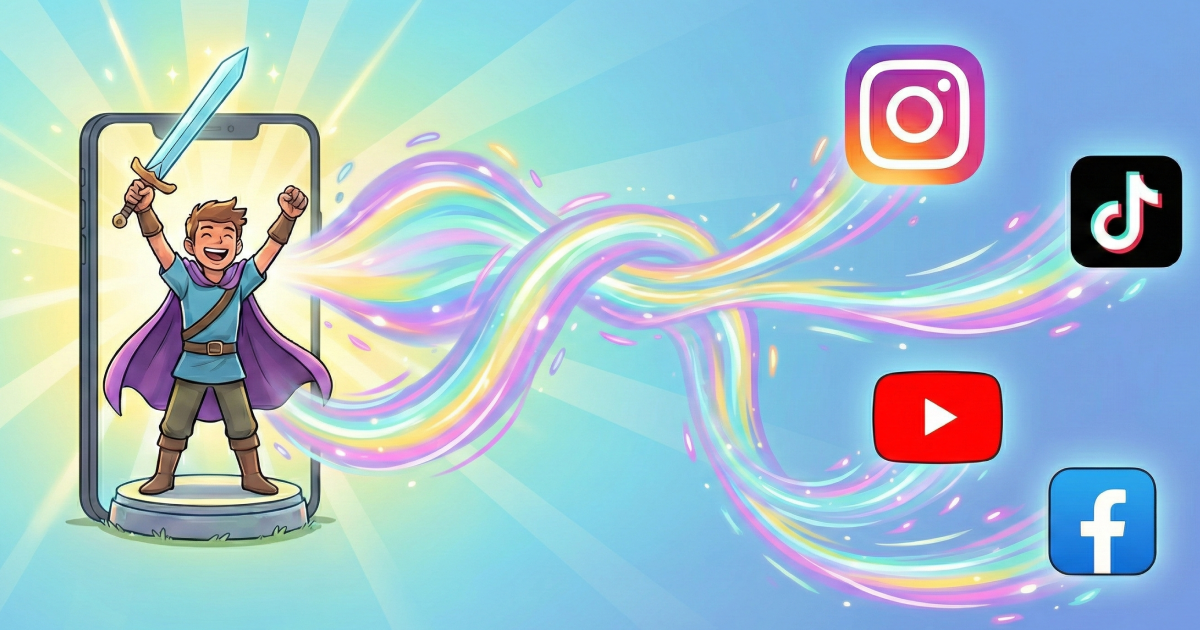
Turning Player Achievement into Organic Growth for your Mobile Game

For those building mobile games, there is a persistent tension between two equally necessary areas of focus: crafting immersive player experiences that excite players and the strategic marketing of user acquisition.
It is a difficult balance to maintain. In the early stages, it can be frustrating to see a high-quality project buried by social media platform algorithms. At scale, that frustration often evolves into a financial weight, feeling trapped in a cycle of feeding expensive ads.
In today's landscape, traditional marketing isn't just a budget line item; it is a barrier that often feels disconnected from the actual joy of the game. You can’t bring in new players without it, but spending time on it takes away from the thing you love most: making a killer game.
The Scaling Wall: When Traditional UA Falters
The current environment for mobile growth is reaching a point of diminishing returns. Industry benchmarks for 2026 highlight a reality that is increasingly difficult for studios to navigate:
Prohibitive Entry Costs: Cost Per Install (CPI) is no longer a minor hurdle. In competitive markets, studios are seeing CPIs ranging from $2.50–$5.00+ on iOS and exceeding $3.25 on Android (Mega Digital CPI Mobile Game Guide, 2026 projections).
The Thinning "Halo Effect": Developers often rely on paid ads to trigger "organic spillover". Basically, free installs resulting from higher store rankings built over time by paid ads. (Complementarity Between Paid and Organic Installs in Mobile App Advertising, arXiv:2504.16151v1, April 2025).
For a creative team, this creates a high-stakes environment where growth feels dependent on budgets rather than the quality of the game itself. There is, however, an opportunity to bridge this gap by focusing on the one thing ads cannot replicate: the player’s authentic excitement.
Capturing the Spark of Achievement
A player-centric approach aligns marketing with the game’s creative health. High-value players are inherently social; they don't just want to play, they want to be part of a community.
The most potent marketing for a game isn't a polished trailer; it is the moment a player finally conquers a hard boss or unlocks a rare item. In that moment, the player is experiencing the core joy the developer intended.
I don’t think it’s outlandish to say that most players have a natural impulse to share their victories, but that impulse is fragile. If a player must take a screenshot, minimize the app, open a social network, and manually compose a post, the friction is almost always too high. The "magic" of the win evaporates during the process. To turn these moments into growth, a we need to reduce that friction to near zero.
Automating "Bragging Rights"
By integrating sharing as a seamless feature of the gameplay rather than an external chore, studios can turn players into advocates without asking them to “do the work".
Posting Stories (Instagram/Facebook) to user’s accounts shares these winning moments in a timely manner. They disappear in 24 hours. This reduces "social risk" of cluttering a permanent feed while reaching their personal network where trust is highest.
A one-time ask to a user to connect their social accounts, encouraged by a meaningful reward like premium currency or a unique badge, sets the stage for effortless sharing.
And over time, you can turn these sharable moments into an interactive feature of the game. Give players the option to add a reaction selfie or a 15-second gameplay clip ensures the content feels like a personal milestone rather than a corporate advertisement.
Moving Toward a Sustainable Growth Model
Shifting away from a total dependence on paid ads doesn't require a pivot in game design. Instead, it requires identifying the high-emotion triggers that already exist in the game and giving them a megaphone.
Infrastructure tools like Post for Me are designed to handle the technical complexities of these social integrations. By automating the sharing pipeline, they allow the development team to stay focused on the fun of the game while enabling the marketing team to leverage organic, player-driven reach to scale outreach without breaking budgets.
The tension between building a game and marketing it may always exist, but it becomes manageable when a studio empowers its players to do the talking. A player’s celebration isn't just a social post, it's the most efficient growth engine available.
So where do we go from here?
If you're looking to share this strategy with your team, use this as a guide to unlock opportunities to grow organic outreach using player achievements:
Identify Triggers: List the top 3 "High-Emotion" moments in your game (e.g., Level ups, Boss kills, Legendary drops).
Audit Friction: Count the steps a player currently takes to share a win. If it's more than two, it's too many.
Define the Incentive: Choose a reward for the initial social link that is valuable but doesn't break the game economy.
Select Platforms: Start with short-lived Story formats to minimize social friction for the user.
Infrastructure Check: Decide if you will build the social API pipelines in-house or use a tool like Post for Me to handle the automation.